Californian Governor Jerry Brown and US Secretary of the Interior Ken Salazar have just announced a major plan to address long-running contested issues of water governance in the estuaries of the rivers entering the San Francisco Bay. The proposal is:
'a $23-billion proposal intended to improve water deliveries to the San
Joaquin Valley and Southern California and stop the ecological free fall
of the Sacramento-San Joaquin Delta.'
What is to me most impressive is the understanding that Governor Brown conveys of the needs of governance in our current circumstances. With this claim in mind spend some time looking at this clip and analyse some of the arguments put forward. As the colleague who posted me the link said: 'it is a joy to watch'.
Friday, July 27, 2012


Thursday, July 26, 2012
The ultimate 'seagull' manager
'Seagull managing' is a term whose time has come. There is far to much of it in the public sector, including Universities. Here in this article Alex Andreou applies it to David Cameron. The sense in which the term is used can be gleaned by his opening and concluding lines:
'He flies in, makes a lot of noise, dumps on everyone from a great height, and then flies out again.....'
'..Flashy but incompetent, clueless but obdurate – Cameron is the ultimate seagull manager. Whether judged on attitude or aptitude, he is truly, hopelessly bad at his job.'
'He flies in, makes a lot of noise, dumps on everyone from a great height, and then flies out again.....'
'..Flashy but incompetent, clueless but obdurate – Cameron is the ultimate seagull manager. Whether judged on attitude or aptitude, he is truly, hopelessly bad at his job.'
ISSS at San Jose
Clearly a good number of Systems folk knew the way to San Jose. I only managed the first two and half days of the conference (Service Systems, Natural Systems) before having to return to Melbourne.
At their session on Sunday evening Humberto Maturana and Ximena Davila, with assistance from Sebastian Gaggero addressed four questions; (i) who are we? (ii) where do we come from? (iii) where do we go? and (iv) where do we want to go?
Their responses (or at least my notes) were:
See immediate past president David Ing's blog for more background or try the new Facebook site 'Systems science'.
At their session on Sunday evening Humberto Maturana and Ximena Davila, with assistance from Sebastian Gaggero addressed four questions; (i) who are we? (ii) where do we come from? (iii) where do we go? and (iv) where do we want to go?
Their responses (or at least my notes) were:
- (i) we are living in molecular autopoiesis;
- (ii) in our living we conserve our molecular autopoiesis (transformation implies something is conserved); Darwin had to propose a mechanism to explain evolution - they choose to explain evolution in terms of drift, as a process of sliding or conserving coherance with our circumstances i.e., while we live we drift.
- (iii) Birds do not need theories to fly - but we humans invent theories to do what we do even though we do not need theories in our living, yet all theories change our living. Most theories are linear, rather than systemic. We can only stop theories through a human choice. A theory is a system of explanations that one accepts as an explanation. Autopoiesis is an abstraction of the molecular dynamics of our living - laws of nature are abstractions about coherances.
- (iv) Three conditions are needed for purposeful action - knowing + understanding + a means of action at hand (without the latter depression arises). There is a need to recover the relationship between the Anthroposphere and the Biosphere - this requires harmony, not equilibrium. Pollution, poverty etc are all products of linear thinking, but only we can stop this type of thinking and allow wellbeing to arise.
See immediate past president David Ing's blog for more background or try the new Facebook site 'Systems science'.
Passing of Stephen Haines
I was saddened to receive the following this morning. I remember meeting Stephen in 1998; through his business he has been a champion of systems thinking and practice.
'Remembering Stephen Haines
December 23, 1945 - July 2, 2012
As many of you may already know, Stephen Haines lost his battle with cancer on July 2, 2012. Stephen Haines has inspired and mentored many people in their fields of business. He has helped direct and provide sound strategic management skills by using the Systems Thinking Approach®.
As CEO and founder of the Haines Centre for Strategic Management®, Stephen Haines was one of the world's foremost authorities on the Systems Thinking Approach® to Strategic Management (Planning-People-Leadership-Change) to deliver customer value.
He dedicated his life to understanding how living systems work, which he called the Systems Thinking Approach®, based on 50 years of scientific research on systems thinking and the natural way the world works. He traveled the world, keynoting on strategic management, consulting with CEOs, presenting seminars and writing books and articles.
Stephen Haines leaves behind his devoted wife, Jayne, his loving daughter Monica Romero and his adoring grandson, Sebastian Romero. Additionally, many followers of his work will also miss him dearly.
Stephen Haines is remembered most as a positive and inspirational man with a warm and generous spirit by those that knew him best. He will not be forgotten and his legacy lives on through his educational and resource books, articles, and models.'
'Remembering Stephen Haines
December 23, 1945 - July 2, 2012
As many of you may already know, Stephen Haines lost his battle with cancer on July 2, 2012. Stephen Haines has inspired and mentored many people in their fields of business. He has helped direct and provide sound strategic management skills by using the Systems Thinking Approach®.
As CEO and founder of the Haines Centre for Strategic Management®, Stephen Haines was one of the world's foremost authorities on the Systems Thinking Approach® to Strategic Management (Planning-People-Leadership-Change) to deliver customer value.
He dedicated his life to understanding how living systems work, which he called the Systems Thinking Approach®, based on 50 years of scientific research on systems thinking and the natural way the world works. He traveled the world, keynoting on strategic management, consulting with CEOs, presenting seminars and writing books and articles.
Stephen Haines leaves behind his devoted wife, Jayne, his loving daughter Monica Romero and his adoring grandson, Sebastian Romero. Additionally, many followers of his work will also miss him dearly.
Stephen Haines is remembered most as a positive and inspirational man with a warm and generous spirit by those that knew him best. He will not be forgotten and his legacy lives on through his educational and resource books, articles, and models.'
Monday, July 23, 2012
INCOSE Insight
Having had an opportunity to glance at the latest edition of the International Council on Systems Engineering (INCOSE) publication Insight, I would recommend those who can get hold of a copy, if for no other reason than to catch up on the INCOSE discourse.
Kenneth Boulding's insight
I liked Jim Best's posting from ISSS.
| Jim Best | 9:28pm Jul 17 |
There is not much doubt about the demand for general systems theory
under one brand name or another. It is a little more embarrassing to
inquire into the supply. Does any of it exist, and if so where? What is
the chance of getting more of it, and if so, how?
The situation might be described as promising and in ferment, though it
is not wholly clear what is being promised or brewed.
--- Boulding, 1956 (The Skeleton of Science)
http://www.panarchy.org/boulding/systems.1956.html
Ouch!
--- Boulding, 1956 (The Skeleton of Science)
http://www.panarchy.org/boulding/systems.1956.html
Ouch!
An Ecology of Ideas - Reflections 2
The next ASC conference is planned for 29th July to 4th August 2013 in Suzhou (near Shanghai) in China (hosted by Department of Architecture at Xi'an Jiaotong Liverpool University). As with this year the timing and location will be coordinated with the ISSS conference which will be held 10 days earlier at Haiphong in Vietnam. I look forward to resuming the conversation with my ASC colleagues.
One of the highlights of the conference this year was the opportunity to catch up with Humberto Maturana, Ximena Davila and Sebastian Gaggero from the Escuela Matriztica de Santiago. As always, in my listening I found new distinctions that help me to do what I wish to do in my research. Some of my notes from Humberto's keynote included:
One of the most exciting talks delivered at the conference from my perspective was given by Kathleen Forsythe. The paper was entitled 'Recursion in language and learning: what autism teaches us about praxis.' Whilst impressive in its own right, what I found even more impressive about the work reported was the totally new system of schooling that Kathleen and her colleagues are developing in Canada built largely on understandings from Maturana's work. This innovation is known as the SelfDesign Learning Community which is a unique online learning environment and Class 1 independent school of over 2000 students, many of whom are autistic or have special needs. The corporate controllers of contemporary universities (and education policy) might well look to this example for the learning pathway(s) that they implicitly or explicitly reject - and which brings into question the social mission of the university.
Rex Wyler and Peter Harries-Jones both delivered keynotes and contributed to the conversation with Governor Brown. Peter's account of the massive loss of honey bees across North America was a fitting parable for our times. Rex Wyler, a co-founder of Greenpeace, reflected on how minimal the gains were from over 40 years of environmentalism, despite the evidence to support action. He made the good point that 'debt is pretend energy' and that the G20 has $70 trillion of debt. Later Rex joined a panel with Nora Bateson and Ralph Abraham to discuss some of these pressing issues. My own reflections triggered by this discussion included:
Many other presentations were stimulating, triggering new reflections and questions. Ranulph Glanville's experience showed through in his contribution to the Reflexivity Panel. Fred Steier and Stuart Umpleby gave well considered contributions as well - the latter on obstacles to reflexivity theory in economics.
Judi Lombardi, a consistent contributor to ASC meetings gave another sterling 'paper' in which, as always, she set out to bring congruence between her espoused theories and theories-in-use. In addition through her efforts we have records of our doings.
One of the highlights of the conference this year was the opportunity to catch up with Humberto Maturana, Ximena Davila and Sebastian Gaggero from the Escuela Matriztica de Santiago. As always, in my listening I found new distinctions that help me to do what I wish to do in my research. Some of my notes from Humberto's keynote included:
- nouns obscure the verbs that constitute them (this is clearly the case also with the noun system!)
- we live in trust that a fundamental inertia operates e.g. that an object placed on a table will remain there
- recursion can be understood through living every moment which occurs on top of its (living's) previous operation - and something new emerges
- what we conserve in our living is an organism-niche unity ..which arise mutually. Evolution operates through the conservation of organism-niche unities
- we are emotional beings ..that use our rationality to validate or to invalidate our emotions
One of the most exciting talks delivered at the conference from my perspective was given by Kathleen Forsythe. The paper was entitled 'Recursion in language and learning: what autism teaches us about praxis.' Whilst impressive in its own right, what I found even more impressive about the work reported was the totally new system of schooling that Kathleen and her colleagues are developing in Canada built largely on understandings from Maturana's work. This innovation is known as the SelfDesign Learning Community which is a unique online learning environment and Class 1 independent school of over 2000 students, many of whom are autistic or have special needs. The corporate controllers of contemporary universities (and education policy) might well look to this example for the learning pathway(s) that they implicitly or explicitly reject - and which brings into question the social mission of the university.
Rex Wyler and Peter Harries-Jones both delivered keynotes and contributed to the conversation with Governor Brown. Peter's account of the massive loss of honey bees across North America was a fitting parable for our times. Rex Wyler, a co-founder of Greenpeace, reflected on how minimal the gains were from over 40 years of environmentalism, despite the evidence to support action. He made the good point that 'debt is pretend energy' and that the G20 has $70 trillion of debt. Later Rex joined a panel with Nora Bateson and Ralph Abraham to discuss some of these pressing issues. My own reflections triggered by this discussion included:
- Ralph Abraham's point that the mathematics of complex systems are not predictive means that purposeful action has to be based on a form of not knowing or deliberative judgement
- Turning to the education system as a potential source of innovation and change as several speakers did is to my mind not likely to succeed. I would go further and claim that in respect of the relationship between humans and the biophysical world most education systems fail largely because the issues are disembodied and taught outside a framework of praxis - the wrong people with the wrong understandings have their hands on the rudder of education.
- I wondered what might be gained if members of GetUp, Avaaz or 38Degrees became more aware of cybersystemic understandings and praxes?
Many other presentations were stimulating, triggering new reflections and questions. Ranulph Glanville's experience showed through in his contribution to the Reflexivity Panel. Fred Steier and Stuart Umpleby gave well considered contributions as well - the latter on obstacles to reflexivity theory in economics.
Judi Lombardi, a consistent contributor to ASC meetings gave another sterling 'paper' in which, as always, she set out to bring congruence between her espoused theories and theories-in-use. In addition through her efforts we have records of our doings.
Sunday, July 22, 2012
An Ecology of Ideas - Reflections 1
The American Society of Cybernetics (ASC) and the Bateson Idea Group (BIG - see this link also) co-hosted a conference from 9-13th July at Asilomar - near Monterey - that well and truly lived up to its name. Those present, the setting and the emergent conversations certainly created a rich and rewarding ecology of ideas. In coolish but energising temperatures due to the sea fret (fog) the site proved ideal, though a little more sun would have revealed more of the magnificent views (see photo taken from my room).
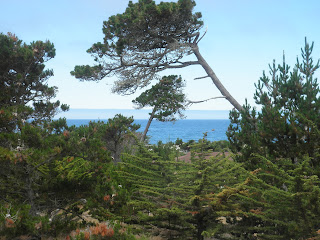 For me the conference started on a high note when I was invited, as part of a small group with interests in the environment and ecology, to have afternoon tea with Californian Governor Jerry Brown. It was a wide-ranging and free-flowing conversation with someone who clearly understood systems and cybernetic ideas and thinking. Later, after the showing of Nora Bateson's film about her father, Gregory Bateson (the reason for Jerry being present), Jerry gave an impromptu public talk in which he articulated a view of governance based on the key cybernetic notion of responding to feedback and articulating a course - a purpose. It was for me very affirming given what we are trying to do in the Systemic Governance Research Program at Monash and The Open University. I left a copy of my book 'Systems Practice' with Jerry. Who knows what might emerge from the conversation? I do know that he asked Nora Bateson to forward to him what she considered the best papers/presentations of the conference.
The conference was organised around three themes: paradigm, recursion and praxis. This worked well, through there is always room for improvement in aligning espoused theory with what becomes theory-in-use. Klaus Krippendorff's 80th birthday was celebrated at the conference. He delivered an insightful and stimulating keynote paper - I hope he turns it into a publication. He made available copies of his chapter 'Pathology, Power and Emancipation' from 'On Communicating Otherness, Meaning and Information', Fernando Bermejo (Ed.) New York: Routledge, 2009. I commend it to anyone wishing to respond to critiques that suggest systems and cybernetics approaches do not deal adequately with power.
Graham Barnes, a Batesonian family therapist also provided a stimulating keynote in which he started by asking: Is the world loving? He moved on to suggest this was the wrong question, posing instead the question: Do I love the system that I call I, you, we, it? Then in a shift towards responsibility he reframed the question as: Is Graham's world loving? Or, Is the world we are making loving?
I took from Terry Deacon's keynote reminders about the operation of constraints (also addressed by Mauro Ceruti in his book 'Constraints and Possibilities. The Evolution of Knowledge and the Knowledge of Evolution'). Amongst many points Terry said:
Marilyn Wedge, another Batesonian family therapist gave a moving talk about her own praxis in the context of increased medical labeling of children as having particular disorders and the prescribed drug culture that follows. Her experience is discussed in her new book: Wedge, M. (2011) Suffer the Children. The case against labeling and medicating and an effective alternative. WW Norton & Co.
My own paper was well received and stimulated several good conversations. The title and abstract are posted below (as an aside Jerry Brown's first question to me was 'what is stationarity'? He had read the abstracts of those joining him for tea in advance!)

The conference was organised around three themes: paradigm, recursion and praxis. This worked well, through there is always room for improvement in aligning espoused theory with what becomes theory-in-use. Klaus Krippendorff's 80th birthday was celebrated at the conference. He delivered an insightful and stimulating keynote paper - I hope he turns it into a publication. He made available copies of his chapter 'Pathology, Power and Emancipation' from 'On Communicating Otherness, Meaning and Information', Fernando Bermejo (Ed.) New York: Routledge, 2009. I commend it to anyone wishing to respond to critiques that suggest systems and cybernetics approaches do not deal adequately with power.
Graham Barnes, a Batesonian family therapist also provided a stimulating keynote in which he started by asking: Is the world loving? He moved on to suggest this was the wrong question, posing instead the question: Do I love the system that I call I, you, we, it? Then in a shift towards responsibility he reframed the question as: Is Graham's world loving? Or, Is the world we are making loving?
I took from Terry Deacon's keynote reminders about the operation of constraints (also addressed by Mauro Ceruti in his book 'Constraints and Possibilities. The Evolution of Knowledge and the Knowledge of Evolution'). Amongst many points Terry said:
- in the absence of constraints relations break down (the GFC is to me a good case in point)
- work is need to create constraints and constraints are needed to do work (quoting Stuart Kaufman);
- he claims that the 'whole is less than the some of the parts' is a better framing than the traditional aphorism
- he also claims that self-organisation alone is not enough - there is also a need to generate order.
Marilyn Wedge, another Batesonian family therapist gave a moving talk about her own praxis in the context of increased medical labeling of children as having particular disorders and the prescribed drug culture that follows. Her experience is discussed in her new book: Wedge, M. (2011) Suffer the Children. The case against labeling and medicating and an effective alternative. WW Norton & Co.
My own paper was well received and stimulated several good conversations. The title and abstract are posted below (as an aside Jerry Brown's first question to me was 'what is stationarity'? He had read the abstracts of those joining him for tea in advance!)
Paradigm shift towards systemic and adaptive governance:
praxis relevant to a structurally-coupled social-biophysical system?
Ray Ison
Communication & Systems Department, The Open University,
UK; Systemic Governance Research Program, Monash Sustainability
Institute, Monash University, Clayton, Australia
The prevailing paradigm in the governance of the
relationship between humans and the biophysical world is characterised by joint
commitments to scientism and dualistic thinking. Currently governance, if understood
as enacting cybernetic processes that maintain the quality of relationships between
humans and the biosphere, can be seen to be failing on many fronts. Over the
last 50 years, for example, the governance of water catchments, or basins, has
been guided by commitments to “stationarity” encompassing commitments to linear
causality, prediction and extrapolation especially within disciplines such as
hydrology and water engineering.
Momentum is now growing to address the limitations of this paradigm in
the face of a worsening global water crisis that threatens security of supply
and food production as well as loss of many vital ecosystems services. This ‘problematique’ raises two significant
questions for praxis: (i) what form of praxis might best contribute to paradigm
shift in these circumstances? (a corollary of which is: Is the concept of
paradigm relevant to such circumstances?); (ii) what constraints and
possibilities does a conception of rivers as the structural coupling of two systems
– the human and biophysical – offer to praxis innovations that offer an
effective break with dualistic thinking and acting? These questions frame a
proposal for a systemic inquiry into forms of governance more suited to the
contemporary circumstances of humans, and the growing recognition of the
negative impacts of the Anthropocene, which those attending the session will be
invited to join. While the focus is on water systems the inquiry purpose is to invent
ways of acting in theory-informed ways (i.e., praxis) that gives rise to
systemic and adaptive governance at levels ranging from the international to
the program or project. The presentation
will develop and build upon some of the revealing and concealing features
of Maturana’s account of structural coupling.
Tuesday, July 17, 2012
Follow ISSS conference activity
Current ISSS president David Ing is keeping track of many of the ISSS conference activities on his Blog. The postings are worth a look.
Friday, July 13, 2012
Climate change adaptation navigator launched
A Climate Change Adaptation Navigator has recently been launched for the State of Victoria. This web-based
application is designed to assist local and state governments as well
as regional organisations in the process of adapting to the impacts of
climate change. It arises from research funded under VCCCAR and more specifically a research project
‘Framing multi-level and multi-actor adaptation responses in the Victorian context’. The framework was developed in collaboration with three local
governments in Victoria with input from state government stakeholders. Researchers came from RMIT the University of Melbourne and Monash (more specifically the Systemic Governance Research Program within Monash Sustainability Institute).
As the introduction to the Navigator says:
'Adapting to climate change is a complex task. The Climate Change
Adaptation Navigator is a flexible guidance framework to allow
indviduals and organisations to explore and find their way through climate change adaptation.
This guidance framework has been designed with decision makers at the local, regional and state level in Victoria (Australia) in mind. However, it may also be useful for government organisations in other parts of the world, private sector organisations or interested individuals from various backgrounds.'
Sunday, July 08, 2012
More great jazz - with a tango leitmotif
Friday night the Christians Kirche was an excellent venue for Danish quintet, the Tangoorkestret. The music was original and engaging and the acoustics helped make it immediate. I was sorry to have to leave before hearing Sophisticated Ladies who made their first appearance Saturday night.
photo by Nils Olander
photo by Nils Olander
Friday, July 06, 2012
Great Jazz last night
In a precursor to the Copenhagen Jazz festival which starts today we took in a great concert last night at Jazz House Monmartre. The systemic nature of the performance was a delight with all aspects of feedback processes and emergence to be experienced. Paolo Fresu was brilliant on trumpet and horn as was Jan Lundgren on piano. Their album together has sold over 50,000 copies. The base player (Jesper Lundgaard) and drummer (Morten Lund) were of an equivalent high standard. A great night and a fitting way to celebrate a recent bithday and the conclusion of a successful PhD training course in Systems Thinking in Practice as part of the European Farming Systems Research Conference in Aarhus.
Shareholder pride
Hepburn Wind in Victoria has won the World Energy Award 2012!
The World Wind Energy Conference
is winding up in Bonn, Germany with the special focus this year being
‘Community Power – Citizens Power’, recognising the power of the
community energy model.
We are delighted and humbled to have been awarded the prestigious World Wind Energy Award 2012.
At the invitation of the World Wind Energy Association, our Community Officer, Taryn Lane, presented a paper on the Hepburn Wind story. (No member funds were applied to Taryn’s visit to Germany.)
Last night Taryn accepted the award on behalf of all who have worked to bring the project to fruition. In particular she acknowledged the vision and critical contributions to the project of our founder Per Bernard and our Chairman Simon Holmes à Court, as well as key contributions from project partners, including Sustainability Victoria.
The WWEA Board has recognised our work in introducing large scale community wind power to Australia, as part of a citizen’s movement aiming at a fundamental energy transformation.
The WWEA appreciates in particular that other communities in Australia are now using the ‘Hepburn Model’, as it is commonly referred, in order to develop their own community power projects. The WWEA made particular reference to the role that Embark is playing to catalyse the sector.
Stefan Gsänger, Secretary of the WWEA said:
“The award is given to the initiators of the Hepburn wind farm for launching Australia's first and groundbreaking community initiative that led to a 4.1 MW community owned wind farm, an excellent answer in particular in order to increase social understanding and acceptance of wind power. Seen from outside of Australia, the project may appear small. However, the Hepburn wind farm stands for a social movement outside the strong fossil lobby in Australia.
WWEA would like to express its willingness to work closely with the Australian wind and in particular the community wind sector and to extend its full support and cooperation in fostering the transformation of Australia towards 100% renewable energy and a strengthened understanding of the importance of sustainability.
With the award, WWEA would also like to encourage the government of Victoria and Australia as well as governments around the world to support communities in their efforts to harvest clean and inexhaustible wind power, for their own benefit and for the benefit of our planet.”
The award joins an impressive list of accolades that now ranges from local to national and now through to global recognition including the Climate Alliance Innovator Award 2010, the Victorian Premier’s Sustainability Award 2011, the Banksia Environment Award 2011 and the Ethical Investor Australian Sustainability Award 2011.
As a shareholder I am delighted with this award.
We are delighted and humbled to have been awarded the prestigious World Wind Energy Award 2012.
At the invitation of the World Wind Energy Association, our Community Officer, Taryn Lane, presented a paper on the Hepburn Wind story. (No member funds were applied to Taryn’s visit to Germany.)
Last night Taryn accepted the award on behalf of all who have worked to bring the project to fruition. In particular she acknowledged the vision and critical contributions to the project of our founder Per Bernard and our Chairman Simon Holmes à Court, as well as key contributions from project partners, including Sustainability Victoria.
The WWEA Board has recognised our work in introducing large scale community wind power to Australia, as part of a citizen’s movement aiming at a fundamental energy transformation.
The WWEA appreciates in particular that other communities in Australia are now using the ‘Hepburn Model’, as it is commonly referred, in order to develop their own community power projects. The WWEA made particular reference to the role that Embark is playing to catalyse the sector.
Stefan Gsänger, Secretary of the WWEA said:
“The award is given to the initiators of the Hepburn wind farm for launching Australia's first and groundbreaking community initiative that led to a 4.1 MW community owned wind farm, an excellent answer in particular in order to increase social understanding and acceptance of wind power. Seen from outside of Australia, the project may appear small. However, the Hepburn wind farm stands for a social movement outside the strong fossil lobby in Australia.
WWEA would like to express its willingness to work closely with the Australian wind and in particular the community wind sector and to extend its full support and cooperation in fostering the transformation of Australia towards 100% renewable energy and a strengthened understanding of the importance of sustainability.
With the award, WWEA would also like to encourage the government of Victoria and Australia as well as governments around the world to support communities in their efforts to harvest clean and inexhaustible wind power, for their own benefit and for the benefit of our planet.”
The award joins an impressive list of accolades that now ranges from local to national and now through to global recognition including the Climate Alliance Innovator Award 2010, the Victorian Premier’s Sustainability Award 2011, the Banksia Environment Award 2011 and the Ethical Investor Australian Sustainability Award 2011.
As a shareholder I am delighted with this award.
Tuesday, June 26, 2012
Rio+20: a contribution from The Open University (UK)
Althought the Rio+20 Declaration has been signed and heavily criticised, the issues that shaped and flow from the Rio conversation are critical to us all. As a contribution to the Rio+20 discourse eight Open University academics concerned about sustainable development joined together to reflect on the Rio+20 progress and
prospects, and demonstrate that international gatherings of political
leaders are not (fortunately?) the only game in town.
Lugano Systems Summer School

Greetings from Lugano!
Dear
Ray
Receive our greetings from LSS 2012, which is well under way with an excellent and very sympathetic group of participants.
Three of them come from the OU and we appreciate them all very much.
As I am very, very busy, pardon me for being so short --
Kind regards from beautiful Lugano
Werner (with Kathy)
Receive our greetings from LSS 2012, which is well under way with an excellent and very sympathetic group of participants.
Three of them come from the OU and we appreciate them all very much.
As I am very, very busy, pardon me for being so short --
Kind regards from beautiful Lugano
Werner (with Kathy)
Sunday, June 17, 2012
Unpacking the 'systems' in Earth Systems and social-ecological systems thinking
On Monday next I am a guest of the Stockholm Environment Institute where I will be presenting a BBL Seminar (brown bag lunch) entitled:
“'Earth System', 'Social-ecological system': what is meant by 'system'?” at 12.15.
For some time now I have been concerned about the lack of reflexivity in the use of the concept System and what this means for policy and praxis, particularly moves towards systemic governance.
This is potentially a critique of a different kind to that delivered by Maarten Hajer recently (see from minute 53 on) and that discussed in this recent post from David Ing.
This is potentially a critique of a different kind to that delivered by Maarten Hajer recently (see from minute 53 on) and that discussed in this recent post from David Ing.
Saturday, June 16, 2012
New Chapter, New Book

At the invitation of the editors I have contributed a chapter to this book entiled'
Ison. R.L. (2012) A cybersystemic framework for practical action. In Murray, J., Cawthorne, G., Dey, C., and Andrew, C. eds. Enough for All Forever. A Handbook for Learning about Sustainability, pp. 269-84. Champaign, Illinois: Common Ground Publishing.
This book can now be purchased from the publisher's online bookstore.
Subscribe to:
Posts (Atom)