New Oz think tank: will it make a difference - is this enough?
For some time I have been conscious that The Australia Institute seemed to be the only critical, alternative voice in town (i.e. Oz). Thinks tanks have an important role but I must admit to not knowing the lay of the land here very well, as yet.
None-the-less it is good to see a new one, New Matilda, launched to provide a much needed set of additional perspectives.
Friday, November 24, 2006


What would the Earth be like if you took humans away?
An intriguing article in New Scientist, worth a read. What it does not address is how, if at all, we might continue to co-evolve as a species with our world.
An intriguing article in New Scientist, worth a read. What it does not address is how, if at all, we might continue to co-evolve as a species with our world.
Thursday, November 23, 2006
Sowing the seeds for systemic success
An inspiring story on last night's 7.30 report on ABC TV tells how a Festival of Healthy Living initiative of Melbourne's Royal Childrens' Hospital is helping to build resilience in disadvantaged communities. It seems to me a good example of dealing with a complex issue systemically. In the programme 'the hospital's mental health service works with professional performers to help school students create a fun show in which they learn how to juggle the ups and downs of life'. This has had systemic effects throughout the community.
Lets hope it can be sustained and the gains institutionalised in some way.
An inspiring story on last night's 7.30 report on ABC TV tells how a Festival of Healthy Living initiative of Melbourne's Royal Childrens' Hospital is helping to build resilience in disadvantaged communities. It seems to me a good example of dealing with a complex issue systemically. In the programme 'the hospital's mental health service works with professional performers to help school students create a fun show in which they learn how to juggle the ups and downs of life'. This has had systemic effects throughout the community.
Lets hope it can be sustained and the gains institutionalised in some way.
Broadband a disgrace - Rupert Murdoch agrees with me
It is not often I find Rupert agreeing with me. But on the matter of broadband we are in total agreement (see my earlier posting).
He is reported as saying:
“I think it is a disgrace, I think we should be spending – the Government with Telstra should be spending – $10 billion or $12 billion on it (so it gets to) every town in Australia – they do it in Japan, they do it in South Korea, we should be able to do it here,” he said.
“We are being left behind and we will pay for it.”
It is not often I find Rupert agreeing with me. But on the matter of broadband we are in total agreement (see my earlier posting).
He is reported as saying:
“I think it is a disgrace, I think we should be spending – the Government with Telstra should be spending – $10 billion or $12 billion on it (so it gets to) every town in Australia – they do it in Japan, they do it in South Korea, we should be able to do it here,” he said.
“We are being left behind and we will pay for it.”
IT systems, ID cards, privacy .....and kids data bases
A significant report about these issues has just been released and gained media attention. As a colleague notes:
'These are related to the NHS IT programme. They were inspired by ministers' belief that NHS IT was working, and so could be 'rolled out' to other areas of 'e-government'. If experience - and the courts - support [the view arrived at in the report] that the children's databases are both unsafe and illegal, this will have dire effects on CfH [Connecting for Health]. NHS computing will fail similar safety tests, and keeping children's records on central NHS systems without the consent of both children and their parents will be unlawful. The NHS must therefore provide for treating dissidents without the details being recorded on central systems.'
Next Tuesday, 29th November a national campaign will be launched to persuade people to opt out of NHS central data collection at a meeting of No2ID at Imperial College [London]. The meeting publicity has also been released.
A significant report about these issues has just been released and gained media attention. As a colleague notes:
'These are related to the NHS IT programme. They were inspired by ministers' belief that NHS IT was working, and so could be 'rolled out' to other areas of 'e-government'. If experience - and the courts - support [the view arrived at in the report] that the children's databases are both unsafe and illegal, this will have dire effects on CfH [Connecting for Health]. NHS computing will fail similar safety tests, and keeping children's records on central NHS systems without the consent of both children and their parents will be unlawful. The NHS must therefore provide for treating dissidents without the details being recorded on central systems.'
Next Tuesday, 29th November a national campaign will be launched to persuade people to opt out of NHS central data collection at a meeting of No2ID at Imperial College [London]. The meeting publicity has also been released.
Sunday, November 12, 2006
NHS staff in London lack confidence in the new IT system
according to an article on the Amicus Union web-site.
"According to an independent survey commissioned by Amicus union , NHS staff in London lack confidence in the implementation of the NHS' controversial new IT system to link GP surgeries to hospitals. Only nine per cent of respondents believed that their views had been taken into account and only eight per cent believed the new system will represent value for money. Eighteen per cent disagreed with the statement 'the new IT system will help them do their jobs better' and 49 per cent did not know. The respondents were asked a number of questions on their attitudes towards the implementation and eventual outcome of the IT new system. A surprising number of respondents were unable to answer many of the questions, choosing the "don't know" option. 42% of the respondents did not know whether the new IT system for transferring patients records between GP surgeries and hospitals would be quicker and more efficient. 48% did not know whether the new IT system would decrease bureaucracy. The survey was conducted to gauge the level of consultation over the introduction of new IT systems in the NHS. NHS Connecting for Health is delivering the National Programme for IT to bring modern computer systems into the NHS aimed at improving patient care and services. The NHS over the next ten years intends to connect over 30,000 GPs in England to almost 300 hospitals and give patients access to their personal health and care information. BT, is responsible for deploying NPfIT (National Programme for IT) software in London. Whilst the union acknowledges the importance of the new IT system for improving patient care, the lack of staff involvement is symptomatic of the NHS' and its providers failure to listen to its staff who are responsible for delivering patient care. Amicus is calling on the NHS and its providers to give end users a greater say and more information on the delivery of the new IT system. Whilst the NHS has undoubtedly got better, morale amongst health service employees is at rock bottom, made worse by a series of rapidly introduced changes without the involvement of staff. . ."
according to an article on the Amicus Union web-site.
"According to an independent survey commissioned by Amicus union , NHS staff in London lack confidence in the implementation of the NHS' controversial new IT system to link GP surgeries to hospitals. Only nine per cent of respondents believed that their views had been taken into account and only eight per cent believed the new system will represent value for money. Eighteen per cent disagreed with the statement 'the new IT system will help them do their jobs better' and 49 per cent did not know. The respondents were asked a number of questions on their attitudes towards the implementation and eventual outcome of the IT new system. A surprising number of respondents were unable to answer many of the questions, choosing the "don't know" option. 42% of the respondents did not know whether the new IT system for transferring patients records between GP surgeries and hospitals would be quicker and more efficient. 48% did not know whether the new IT system would decrease bureaucracy. The survey was conducted to gauge the level of consultation over the introduction of new IT systems in the NHS. NHS Connecting for Health is delivering the National Programme for IT to bring modern computer systems into the NHS aimed at improving patient care and services. The NHS over the next ten years intends to connect over 30,000 GPs in England to almost 300 hospitals and give patients access to their personal health and care information. BT, is responsible for deploying NPfIT (National Programme for IT) software in London. Whilst the union acknowledges the importance of the new IT system for improving patient care, the lack of staff involvement is symptomatic of the NHS' and its providers failure to listen to its staff who are responsible for delivering patient care. Amicus is calling on the NHS and its providers to give end users a greater say and more information on the delivery of the new IT system. Whilst the NHS has undoubtedly got better, morale amongst health service employees is at rock bottom, made worse by a series of rapidly introduced changes without the involvement of staff. . ."
Friday, November 10, 2006
Powerful prose - 'Memoir' John McGahern's last book
I described earlier how much I appreciated McGahern's 'That they may face the rising sun'. Now, having read 'Memoir' it is possible to comprehend and appreciate the seminal childhood experiences from which his writing emerges. For me, he summed up what it was like growing up in his Ireland when he says:
'In that country [Ireland], individual thought and speech were discouraged. Its moral climate can be glimpsed in the warning catch phrases: a shut mouth catches no flies; think what you say but don't say what you think; the less you say, the more you'll hear. By 1950, against the whole spirit of the 1916 Proclaimation, the State had become a theocracy in all but name. The Church controlled nearly all of education, the hospitals, the orphanages, the juvenile prison systems, the parish halls. Church and State worked hand in hand. Women and single men were in a lower scale on the public services, a higher scale was in place for married men. The breaking of pelvic bones took place during difficult births in hospitals because it was thought to be more in conformity with Catholic teaching than Caesarian section........ People did not live in Ireland then. They lived in small intense communities,which often varied greatly in spirit and character over the course of even a few miles.' (p.210).
If one needs it, his experience provides a powerful, personal rationale for the separation of powers - of church and state.
We benefit immensely from his capacity to rise above his experience, generate such prose and to conclude:
'Through work and reading and reflection I had come to separate morals and religion, to see morals as simply our relationship with other people and the creatures of the earth and air, and religion as our relationship with our total environment, the all that surrounds our little lives. I had come to see the story of Jesus as a story among other sacred stories that sought to explain and make palatable the inexplicable.' (p.222)
As I read I wondered what the book evoked for my colleague John, who grew up in a similar Ireland and, as with McGahern, lost a Sue, whom he loved dearly, to breast cancer.
I described earlier how much I appreciated McGahern's 'That they may face the rising sun'. Now, having read 'Memoir' it is possible to comprehend and appreciate the seminal childhood experiences from which his writing emerges. For me, he summed up what it was like growing up in his Ireland when he says:
'In that country [Ireland], individual thought and speech were discouraged. Its moral climate can be glimpsed in the warning catch phrases: a shut mouth catches no flies; think what you say but don't say what you think; the less you say, the more you'll hear. By 1950, against the whole spirit of the 1916 Proclaimation, the State had become a theocracy in all but name. The Church controlled nearly all of education, the hospitals, the orphanages, the juvenile prison systems, the parish halls. Church and State worked hand in hand. Women and single men were in a lower scale on the public services, a higher scale was in place for married men. The breaking of pelvic bones took place during difficult births in hospitals because it was thought to be more in conformity with Catholic teaching than Caesarian section........ People did not live in Ireland then. They lived in small intense communities,which often varied greatly in spirit and character over the course of even a few miles.' (p.210).
If one needs it, his experience provides a powerful, personal rationale for the separation of powers - of church and state.
We benefit immensely from his capacity to rise above his experience, generate such prose and to conclude:
'Through work and reading and reflection I had come to separate morals and religion, to see morals as simply our relationship with other people and the creatures of the earth and air, and religion as our relationship with our total environment, the all that surrounds our little lives. I had come to see the story of Jesus as a story among other sacred stories that sought to explain and make palatable the inexplicable.' (p.222)
As I read I wondered what the book evoked for my colleague John, who grew up in a similar Ireland and, as with McGahern, lost a Sue, whom he loved dearly, to breast cancer.
I am sometimes surprised how little some people know about the Open University
This experience mainly applies to people I would expect to know better (they have usually been involved in Higher Education for some time but seem to have a very limited appreciation of the diversity of 'university models' that exist).
The OU pioneered supported open learning. It has a main campus at Walton Hall, Milton Keynes, where about 3000 staff work. It has traditional academic Faculties such as Science, Arts, Humanities, Business School, Technology, Maths & Computing (the latter two are about to merge), Health and Social Care, Education & Languages. In 2004/5 there were 202,853 students in total of whom 162,966 were from the UK. There were 782 part-time and 724 full-time post-graduate research students among these. Staff numbers in 2004/5 were 1114 salaried academic staff, 1409 academic related staff, 1909 support staff and 7497 associate lecturers. Academic staff are engaged in teaching, research, administration and third mission activity as in other HE institutions.
In the 2006 UK National Student Survey a total of 95 per cent of the OU's survey respondents reported that they were satisfied or mostly satisfied with their experience of studying with the OU; the figure puts the OU ahead of all other surveyed providers. The average "overall satisfaction" score of 4.5 of a possible five marks was the highest of any of the 129 institutions across the UK for which the survey results have been published. The OU has retained the overall satisfaction rate that it achieved in 2005. The OU were also rated first for assessment and feedback (as we were in 2005), and third for academic support (as we were in 2005). More than 157,000 students - of whom 8,800 were from the OU - took part in the survey. Further details of the survey can be found at the Teaching Quality Information website.
The achievement of this level of overall satisfaction for the second year running emphatically demonstrates the quality of the OU's teaching and student support.
The Open University's commitment to broadening access to education is being taken to another level with the launch of OpenLearn, its major new open content initiative. The OpenLearn website makes educational resources freely available on the internet, with state-of-the-art learning support and collaboration tools to connect learners and educators.
This £5.65 million project, generously supported by a grant from the William and Flora Hewlett Foundation, will cover a full range of subjects from arts and history to science and nature, at all study levels from access to postgraduate. Available to learners and educators throughout the UK and worldwide, the project will be of particular significance in The Open University's efforts to widen access to hard-to-reach groups and tackle educational disadvantage both within the developed and developing worlds.
On the OpenLearn site material relating to Systems can be found under the Technology heading.
This experience mainly applies to people I would expect to know better (they have usually been involved in Higher Education for some time but seem to have a very limited appreciation of the diversity of 'university models' that exist).
The OU pioneered supported open learning. It has a main campus at Walton Hall, Milton Keynes, where about 3000 staff work. It has traditional academic Faculties such as Science, Arts, Humanities, Business School, Technology, Maths & Computing (the latter two are about to merge), Health and Social Care, Education & Languages. In 2004/5 there were 202,853 students in total of whom 162,966 were from the UK. There were 782 part-time and 724 full-time post-graduate research students among these. Staff numbers in 2004/5 were 1114 salaried academic staff, 1409 academic related staff, 1909 support staff and 7497 associate lecturers. Academic staff are engaged in teaching, research, administration and third mission activity as in other HE institutions.
In the 2006 UK National Student Survey a total of 95 per cent of the OU's survey respondents reported that they were satisfied or mostly satisfied with their experience of studying with the OU; the figure puts the OU ahead of all other surveyed providers. The average "overall satisfaction" score of 4.5 of a possible five marks was the highest of any of the 129 institutions across the UK for which the survey results have been published. The OU has retained the overall satisfaction rate that it achieved in 2005. The OU were also rated first for assessment and feedback (as we were in 2005), and third for academic support (as we were in 2005). More than 157,000 students - of whom 8,800 were from the OU - took part in the survey. Further details of the survey can be found at the Teaching Quality Information website.
The achievement of this level of overall satisfaction for the second year running emphatically demonstrates the quality of the OU's teaching and student support.
The Open University's commitment to broadening access to education is being taken to another level with the launch of OpenLearn, its major new open content initiative. The OpenLearn website makes educational resources freely available on the internet, with state-of-the-art learning support and collaboration tools to connect learners and educators.
This £5.65 million project, generously supported by a grant from the William and Flora Hewlett Foundation, will cover a full range of subjects from arts and history to science and nature, at all study levels from access to postgraduate. Available to learners and educators throughout the UK and worldwide, the project will be of particular significance in The Open University's efforts to widen access to hard-to-reach groups and tackle educational disadvantage both within the developed and developing worlds.
On the OpenLearn site material relating to Systems can be found under the Technology heading.
Thursday, November 09, 2006
Understandascope - a second order perspective
On Monday I had a very enjoyable and long lunch with Frank Fisher whose work I have admired over many years. At one stage I tried hard to set it up so that Frank could take a sabbatical at the OU or that we could collaborate on systems-informed environmental education (particularly our Masters in Environmental Decision Making), but in the end it did not eventuate. The good news is that despite the demise of his very influential MSc (due to structural and cost changes in the local MSc 'market') he still has a project based at Monash and a new book which brings together most of his work.
The project is aptly called 'Understandascope' and uses one of Michael Leunig's insightful cartoons to symbolise the project. Frank and I are both interested in taking a double look - understanding understandings! (At the OU we use the same cartoon as an organising metaphor in our course 'Managing Complexity. A systems approach').
The book, 'Response Ability' is doubly welcome - it brings together an important set of ideas developed over a lifetime of contributing to making the difference that makes a difference. It also, perhaps for the first time, makes Frank's ideas accessible as it has sometimes been difficult to keep track of the range and scope of Frank's work.
Frank Fisher also lecturers at the National Centre for Sustainability.
His new publication is entitled RESPONSE ABILITY - Environment, Health and Everyday Transcendence the collected works of Frank Fisher.
Interested readers can purchase a copy of his book for $34.95 (plus GST) from the National Centre for Sustainability, Swinburne University of Technology Hawthorn Campus. Please call +61 3 9214 5997 to place your order.
Or contact the publishers: Vista Publications PO Box 76 St. Kilda Victoria, Australia 3182 Telephone: +61 3 9534 8881
On Monday I had a very enjoyable and long lunch with Frank Fisher whose work I have admired over many years. At one stage I tried hard to set it up so that Frank could take a sabbatical at the OU or that we could collaborate on systems-informed environmental education (particularly our Masters in Environmental Decision Making), but in the end it did not eventuate. The good news is that despite the demise of his very influential MSc (due to structural and cost changes in the local MSc 'market') he still has a project based at Monash and a new book which brings together most of his work.
The project is aptly called 'Understandascope' and uses one of Michael Leunig's insightful cartoons to symbolise the project. Frank and I are both interested in taking a double look - understanding understandings! (At the OU we use the same cartoon as an organising metaphor in our course 'Managing Complexity. A systems approach').
The book, 'Response Ability' is doubly welcome - it brings together an important set of ideas developed over a lifetime of contributing to making the difference that makes a difference. It also, perhaps for the first time, makes Frank's ideas accessible as it has sometimes been difficult to keep track of the range and scope of Frank's work.
Frank Fisher also lecturers at the National Centre for Sustainability.
His new publication is entitled RESPONSE ABILITY - Environment, Health and Everyday Transcendence the collected works of Frank Fisher.
Interested readers can purchase a copy of his book for $34.95 (plus GST) from the National Centre for Sustainability, Swinburne University of Technology Hawthorn Campus. Please call +61 3 9214 5997 to place your order.
Or contact the publishers: Vista Publications PO Box 76 St. Kilda Victoria, Australia 3182 Telephone: +61 3 9534 8881
Connecting for Health - the saga of systemic failure?
The saga with the NHS Connecting for Health (CfH) IT project continues unabated. This article from the Telegraph suggests a government moving into damage limitation mode.
"The Government has admitted that Connecting for Health, the Department
of Health agency in charge of its disastrous NHS IT programme, could be
scrapped.
The admission comes amid growing alarm in the Government at the
spiralling cost of the programme which is likely to end up at £20
billion — £7.6 billion more than its original budget."
Our group of 23 Professors of Computing and Systems (see earlier posting) has continued to monitor what has been happening with CfH and now have a public Wikki with a very wide ranging set of comments and critiques. It includes details of some further actions we have taken as a group (e.g. more letters etc) in our attempt to get government to take seriously our initial request for an independent review.
This recent action suggest that others are now beginning to recognise that they are staring systemic failure in the face!
The saga with the NHS Connecting for Health (CfH) IT project continues unabated. This article from the Telegraph suggests a government moving into damage limitation mode.
"The Government has admitted that Connecting for Health, the Department
of Health agency in charge of its disastrous NHS IT programme, could be
scrapped.
The admission comes amid growing alarm in the Government at the
spiralling cost of the programme which is likely to end up at £20
billion — £7.6 billion more than its original budget."
Our group of 23 Professors of Computing and Systems (see earlier posting) has continued to monitor what has been happening with CfH and now have a public Wikki with a very wide ranging set of comments and critiques. It includes details of some further actions we have taken as a group (e.g. more letters etc) in our attempt to get government to take seriously our initial request for an independent review.
This recent action suggest that others are now beginning to recognise that they are staring systemic failure in the face!
Wednesday, November 08, 2006
Managing strategic risk systemically - the case of Indonesia, Australia and nuclear power
History is a good starting point for appreciating strategic risk - history of understandings, practices and situation. For example anyone entering the nuclear 'debate' ought first, amongst other things, read Wolves Eat Dogs by Martin Cruz Smith or visit Chernyobyl in person.
Australians who have lived, worked, or visited Indonesia might also do well to reflect on their experiences there in the light of today's announcment of a new 'security pact' to be signed by both countries. This pact was negotiated secretly and has cooperation over nuclear power development as a key component. From my experience 'nuclear' and 'Indonesia' are not two terms I would ever choose to associate!! I have lived in Indonesian and have the greatest respect for Indonesian citizens but, reflecting on the physical geography of the archipeligo and the political and institutional history of the Indonesian nation, I am alarmed. Australia's own record in relation to 'technology push' onto Indonesia is also not good. Nor is the record of mine management in relation to the environment.
It seems the setting for yet more systemic failure is being created!
History is a good starting point for appreciating strategic risk - history of understandings, practices and situation. For example anyone entering the nuclear 'debate' ought first, amongst other things, read Wolves Eat Dogs by Martin Cruz Smith or visit Chernyobyl in person.
Australians who have lived, worked, or visited Indonesia might also do well to reflect on their experiences there in the light of today's announcment of a new 'security pact' to be signed by both countries. This pact was negotiated secretly and has cooperation over nuclear power development as a key component. From my experience 'nuclear' and 'Indonesia' are not two terms I would ever choose to associate!! I have lived in Indonesian and have the greatest respect for Indonesian citizens but, reflecting on the physical geography of the archipeligo and the political and institutional history of the Indonesian nation, I am alarmed. Australia's own record in relation to 'technology push' onto Indonesia is also not good. Nor is the record of mine management in relation to the environment.
It seems the setting for yet more systemic failure is being created!
Norway....able to bring its system of social organization to the highest level of development yet achieved in the world
I have been wondering what lessons Australia, as a resource rich nation, could learn from Norway. Here is some background on Norway and its social model, as the first part of my inquiry.
I have been wondering what lessons Australia, as a resource rich nation, could learn from Norway. Here is some background on Norway and its social model, as the first part of my inquiry.
Chemical pollution 'responsible for silent pandemic of brain damage'
For those who know about The Natural Step's conceptual framing of issues associated with sustainable development this new report will only confirm what they already know and accept. It is none-the-less frightening that we have been so reluctant to adopt the precautionary principle in relation to man-made chemicals (in addition to transgenics and, possibly, nano-'organisms' - all 'man-made'). The TNS claim is that it 'uses a scientific, systems-based framework to educate both corporations and governments in how to understand and apply the principles of sustainability in all that they do'.
This disturbing new article says:
"An explosive report from researchers in the United States and Denmark talks of a "silent pandemic" of neurodevelopmental disorders caused by toxic chemicals spilling into the environment.
They include conditions such as autism, attention deficit disorder, mental retardation and cerebral palsy.
The scientists identified 202 industrial chemicals with the potential to damage the human brain, and said they were likely to be the "tip of a very large iceberg". More than 1,000 chemicals are known to be neurotoxic in animals, and are likely to be harmful to humans."
For those who know about The Natural Step's conceptual framing of issues associated with sustainable development this new report will only confirm what they already know and accept. It is none-the-less frightening that we have been so reluctant to adopt the precautionary principle in relation to man-made chemicals (in addition to transgenics and, possibly, nano-'organisms' - all 'man-made'). The TNS claim is that it 'uses a scientific, systems-based framework to educate both corporations and governments in how to understand and apply the principles of sustainability in all that they do'.
This disturbing new article says:
"An explosive report from researchers in the United States and Denmark talks of a "silent pandemic" of neurodevelopmental disorders caused by toxic chemicals spilling into the environment.
They include conditions such as autism, attention deficit disorder, mental retardation and cerebral palsy.
The scientists identified 202 industrial chemicals with the potential to damage the human brain, and said they were likely to be the "tip of a very large iceberg". More than 1,000 chemicals are known to be neurotoxic in animals, and are likely to be harmful to humans."
Wednesday, November 01, 2006
Irene Khan makes so much systemic sense!
On ABC TV last night and again on radio national this morning Irene Khan, Secretary General of Amnesty International, here to receive the Australia Peace Prize at the University of Sydney, demonstrated a powerful, ethical intellect that puts the level of public discourse, and that of the current government, to shame. Her arguments are cogent, ethically grounded and systemic. Her take on the Australian notion of 'mateship' shows how vacuous the PM's views on the same subject are. As she says, this government has renigged on its international responsibilities for creating 'mateship' at a global scale. The failure to sign the Kyoto agreement and to support UN action in Iraq being the more notable examples.
On ABC TV last night and again on radio national this morning Irene Khan, Secretary General of Amnesty International, here to receive the Australia Peace Prize at the University of Sydney, demonstrated a powerful, ethical intellect that puts the level of public discourse, and that of the current government, to shame. Her arguments are cogent, ethically grounded and systemic. Her take on the Australian notion of 'mateship' shows how vacuous the PM's views on the same subject are. As she says, this government has renigged on its international responsibilities for creating 'mateship' at a global scale. The failure to sign the Kyoto agreement and to support UN action in Iraq being the more notable examples.
Wednesday, October 25, 2006
The Australian Prime Minister just does not get it!
The last two weeks have been fascinating here in Oz - a combination of circus and hallelujah! For the first time since coming into office the coalition government has been forced on to the back foot, politically, in relation to its stance on climate change. A number of factors have triggered this shift:
The first is the drought here in Oz and the underlying data about climate patterns and shifts. There are also significant, and distressing, social impacts. Drought, and underlying climate change, begin to be taken seriously by the coalition when it affects economic performance, particularly economic growth rate and the balance of payments.
The second has been the release of the Stern Report, and the resultant criticism, both explicit and implicit, for Australia's stance. The Uk Chancellor, Gordon Brown is to be commended on commissioning the report and attempting to raise the level of awareness, debate (I hope) and, hopefully, action.
The third is that the coalition is suffering in the polls - Australians are by an overwhelming majority dissatisfied with government performance in relation to climate change. Of course all three factors are interrelated.
Fortunately the government, either through clever design, or sheer good luck, has had some projects to announce as evidence of action. Some of these are welcome - others misguided.
Despite the circus (with its light as well as serious moments) what seems apparent to me is that the PM (and his government) just do not get it! (Or as my daughter reminds me, choose not to get it!). What is it that they do not get?
1. Their decision to reject Kyoto was not simply failure to sign a document, as the PM would have us believe, but a rejection of Australia's role as a responsible nation in an era when a new committment to internationalism is urgent. This is a point made lucidly by Irene Khan. Kyoto is flawed - everyone knew that, but it was a first step in what needs to be an on-going process. The stance taken by Australia and the USA has undermined the social and political capital for generating 'Kyoto 2' (as the PM is describing it!). The stance has also weakened Australia's position in international affairs, compounded of course by the government's Iraq policy (on this point see a recent survey of citizens of different countries which shows that most people see the US and George Bush as the biggest threat to international security - and how American's feel about themselves is changing).
2. The arguments as to why Kyoto was not signed appear increasingly specious. As the Stern Report makes clear the situation concerning climate change is a case of massive market failure. I wonder if this message is being taken on board in Canberra and other bastions of neo-classical economic ideology?
3. The stance in Australia can only be put down to one factor - political intervention on behalf of the coal industry (see my earlier posting). 'Clean coal' is both an oxymoron and a dangerous metaphor! Contrast the Australian stance with that of Sweden.
4. Whilst the government has launched a series of projects to address climate change what is singularly lacking is a systemically feasible overall policy. Despite recent denials there is still a policy vaccuum. It remains to be seen as to whether the PM (and the 'dirt digger' states of WA and Queensland) will accept the idea that the next COAG meeting of state and federal governments should be devoted to climate change.
5. Not only is there no coherent overall policy for climate change, the same applies to rural development. Handouts during droughts achieve very little in the long-term. What seems to be lacking is a national strategy for rural development in which all States and Commonweath are working together to effect more sustainable livelihoods for rural Australians. This involves mutifunctionality (as the Europeans describe it) as well as strategies to enhance the relationship between urban and rural Australians. This must also involve biodiversity conservation, management of ecosystem services, national strategies re feral pests and weeds and the provision of adequate services to make living in rural Australia a viable proposition in today's social and cultural context.
6. Finally there is a faith in technology and the overall technology mix that is questionable. New technology requires a conducive institutional environment. The investment in the large solar energy project is welcome. But what about wind? On my recent travels I had dinner with someone who had purchased second-hand wind turbines in the Netherlands and shipped them back to Australia with a view to setting them up in the NSW Hunter Valley. So far he has met only obfuscation and delay in trying to get his scheme going. In the German state of Schleswig-Holstein wind is already capable of providing one-third of energy needs whilst occupying less than 1% of the land area. Also, why are technologies like 'rock heating' missing from the mix?
The States are not above attention. With an election campaign in Victoria and one next year in NSW it is to be hoped that whoever is elected can, as a matter of priority, form their new governments around a whole of government approach to sustainable development.
The last two weeks have been fascinating here in Oz - a combination of circus and hallelujah! For the first time since coming into office the coalition government has been forced on to the back foot, politically, in relation to its stance on climate change. A number of factors have triggered this shift:
The first is the drought here in Oz and the underlying data about climate patterns and shifts. There are also significant, and distressing, social impacts. Drought, and underlying climate change, begin to be taken seriously by the coalition when it affects economic performance, particularly economic growth rate and the balance of payments.
The second has been the release of the Stern Report, and the resultant criticism, both explicit and implicit, for Australia's stance. The Uk Chancellor, Gordon Brown is to be commended on commissioning the report and attempting to raise the level of awareness, debate (I hope) and, hopefully, action.
The third is that the coalition is suffering in the polls - Australians are by an overwhelming majority dissatisfied with government performance in relation to climate change. Of course all three factors are interrelated.
Fortunately the government, either through clever design, or sheer good luck, has had some projects to announce as evidence of action. Some of these are welcome - others misguided.
Despite the circus (with its light as well as serious moments) what seems apparent to me is that the PM (and his government) just do not get it! (Or as my daughter reminds me, choose not to get it!). What is it that they do not get?
1. Their decision to reject Kyoto was not simply failure to sign a document, as the PM would have us believe, but a rejection of Australia's role as a responsible nation in an era when a new committment to internationalism is urgent. This is a point made lucidly by Irene Khan. Kyoto is flawed - everyone knew that, but it was a first step in what needs to be an on-going process. The stance taken by Australia and the USA has undermined the social and political capital for generating 'Kyoto 2' (as the PM is describing it!). The stance has also weakened Australia's position in international affairs, compounded of course by the government's Iraq policy (on this point see a recent survey of citizens of different countries which shows that most people see the US and George Bush as the biggest threat to international security - and how American's feel about themselves is changing).
2. The arguments as to why Kyoto was not signed appear increasingly specious. As the Stern Report makes clear the situation concerning climate change is a case of massive market failure. I wonder if this message is being taken on board in Canberra and other bastions of neo-classical economic ideology?
3. The stance in Australia can only be put down to one factor - political intervention on behalf of the coal industry (see my earlier posting). 'Clean coal' is both an oxymoron and a dangerous metaphor! Contrast the Australian stance with that of Sweden.
4. Whilst the government has launched a series of projects to address climate change what is singularly lacking is a systemically feasible overall policy. Despite recent denials there is still a policy vaccuum. It remains to be seen as to whether the PM (and the 'dirt digger' states of WA and Queensland) will accept the idea that the next COAG meeting of state and federal governments should be devoted to climate change.
5. Not only is there no coherent overall policy for climate change, the same applies to rural development. Handouts during droughts achieve very little in the long-term. What seems to be lacking is a national strategy for rural development in which all States and Commonweath are working together to effect more sustainable livelihoods for rural Australians. This involves mutifunctionality (as the Europeans describe it) as well as strategies to enhance the relationship between urban and rural Australians. This must also involve biodiversity conservation, management of ecosystem services, national strategies re feral pests and weeds and the provision of adequate services to make living in rural Australia a viable proposition in today's social and cultural context.
6. Finally there is a faith in technology and the overall technology mix that is questionable. New technology requires a conducive institutional environment. The investment in the large solar energy project is welcome. But what about wind? On my recent travels I had dinner with someone who had purchased second-hand wind turbines in the Netherlands and shipped them back to Australia with a view to setting them up in the NSW Hunter Valley. So far he has met only obfuscation and delay in trying to get his scheme going. In the German state of Schleswig-Holstein wind is already capable of providing one-third of energy needs whilst occupying less than 1% of the land area. Also, why are technologies like 'rock heating' missing from the mix?
The States are not above attention. With an election campaign in Victoria and one next year in NSW it is to be hoped that whoever is elected can, as a matter of priority, form their new governments around a whole of government approach to sustainable development.
Monday, October 02, 2006



And so back to Melbourne - the good, the bad, the ugly
I have been on the road, more-or-less, for a month. I have driven almost 5000km – some of those day-long trips of up to 12 hours. What impressions am I left with?
The good
Some of the best moments of this trip were unexpected – particular incidents with some of the friends and relatives (often distant) I chose to look up, such as the tears that came when an 83 year old first cousin of my mother’s saw, for the first time, a wedding photo of his parents, in my ‘White family’ manuscript. His parents divorced when he was a boy and his mother had destroyed all photos of his father. Later I heard how his experiences of the depression and of the hypocrisy of the established church had led him towards socialism and ultimately to becoming an active member of the Australian Communist Party – something long suppressed in my branch of the family! There were other, similar moments.
I come back more connected with friends and family and having unearthed some of the multiple narratives that give rise to one’s sense of place and identity. In Ryde Library, quite by accident, I came across a photograph taken outside Ryde Church of England Parochial School in 1873 - I feel confident it included my great-great grandmother and grandfather.
I wondered at the skills needed to read the Australian landscape. Particularly the subtle differences that need to be discerned if one is to avoid being left with a sense of unending sameness. The bark of the trees – see earlier posting – is part of it. Bark, leaves and flowers are used to identify different tree species, which together with soil type are the main features to be used in ‘reading the land’. In Europe the cultural, architectural and biopysical diversity of a 5000km journey would be much more obvious!
I was struck by the evidence of growing catchment consciousness and the never-ending blueness of the day-time sky.
I came back feeling more positive about Melbourne - it is much more accessible and people-friendly than Sydney now is - one can walk easily around Melbourne CBD and inner suburbs and the trams are great asset. Then there is the cafe scene - more accessible in Melbourne. A good city to implement 'walk-to-work day'.
The bad
For much of my trip I thought it was already too hot - a sign of living too long in England perhaps! Or more likely an effect of significant climate change. Fire and very severe drought seem certain over summer.
I was surprised to find that after 12 years the Hume Highway has not yet been completed - there are still several 'death-trap' stretches.
Imagine only one cafe in Darling St, Balmain with internet access!!!!!... and then you have to pay by the 15 minute slot, and the download speed is so slow that you can only get about one file loaded or downloaded per sesssion! Compare this, and the general 'connectivity scene' in Oz with what is happening in Milton Keynes:
'Milton Keynes looks set to become the first British town to get a high-speed wireless
network based on so-called Wimax technology.
Net connection firm Pipex is to trial a network in the town, which should be up and running
by the end of 2006.
Unlike wi-fi technology, Wimax offers high-speed net access over long distances, instead of
just a few metres.
Pipex said it hoped to have Wimax deployed in eight UK towns by 2008'.
This example reflects, it seems, a more pervasive, systemic issue - the lack of significant investment in public infrastructure. There is also a preoccupation with road developments (but not rail) in the major cities. What are the budget surpluses being used for?
I can't understand why Sydney and Melbourne are not following Ken Livingston's lead in London and introducing a congestion charge. Both cities would become much more person and bicycle friendly immediately.
The ugly
One only has to drive through country towns to discern the extent of rural poverty. In one coastal NSW town I visited over 56% of people in the local government area are registered with CentreLink (similar to social security). Australia it seems has become a series of city-based island communities on a vast continent, each with their tribal loyalties (manifest within the Federal Liberal party in terms of the Sydney vs Melbourne cabals). Has Australia an effective national rural development strategy?
It is argued on the web site of the Australian Local Government Association that:
'Soundly based economic and regional development is fundamental to the wellbeing of Australian communities. Effective local government participation is vital to the success of economic development initiatives, and local councils, singly or in groups, have long been at the forefront of such initiatives. They have allocated large amounts of time, energy and resources to promoting economic growth in their areas, and have forged valuable partnerships with business, unions and other key players. '
Despite the rhetoric my recent experience suggests that they are fighting a losing battle! Somewhere in the not too distant past rural Australia has slipped below the horizons of the majority of the population.
Australia still has, it seems, an ecologically sustainable development strategy (or at least it has a web site) hosted by the Department of the Environment and Heritage. The very same department was largely cut out of developing Australia's stance on Kyoto and responsibility for the burgeoning water issues across the nation has been vested in a new Office of Water Resources within the Prime Minister's own Department (not mentioned under 'whats new' on the DEH website!!).
Ribbon development is not common in the UK - here it blights the outer margins of almost every town and city. Planners and developers seem to be conspiring to develop urban fringe mortgage ghettos, something exacerbated by rises in petrol prices and interest rates and underinvestment in public transport. Aesthetically it leaves much to be desired and seems ill-equipped to handle the increased fire frequency we are likely to experience.
During my trip the story of air quality in Sydney's road tunnels hit the headlines. This is a particularly ugly situation, if the report I heard on air is valid. This site explores some of the issues as they stood in 2003 and the RTA gives some 'official' background.
Clover Moore, Lord Mayor of Sydney says:
'There seems to be a real resistance to government investing in public transport infrastructure in Australia's cities in recent decades. I'd go as far as saying there's actually an anti-public transport bias. Public transport has been viewed by governments as a social cost - as a type of welfare program for those who can't afford to drive. The assumption has been that if you are a productive and successful citizen then of course you will always choose to drive a car rather than catch public transport.'
She touches on perhaps the most ugly issue one encounters - a crisis in thinking, and thinking about thinking! This is coupled with, it seems to me, a deficieny in the democracy dialectic! Difference is not valued, promoted, facilitated or respected.
Monday, September 25, 2006
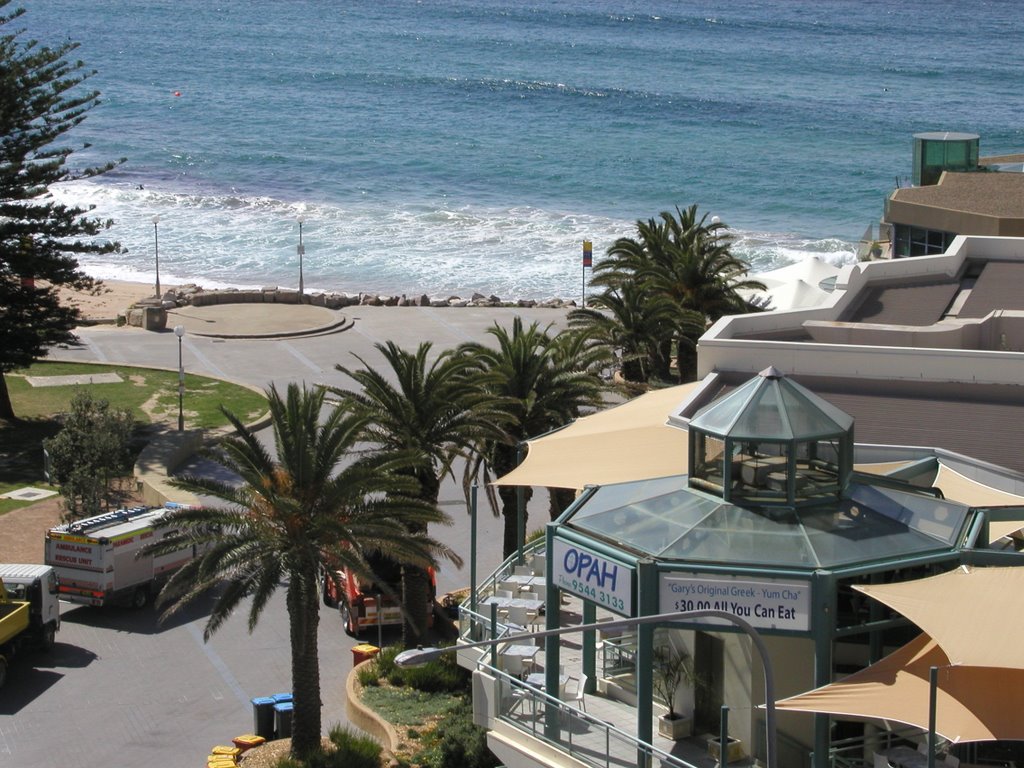
Contemporary images of Oz
Having a coffee in the lounge at Armidale airport – just off the New England Highway I was confronted with the following:
‘Caution
It is an offence to make jokes about bombs or weapons or leave luggage unattended. Penalties exceed $5,000
Aviation Transport Security Regulation 2005’
Overnight on ABC radio national I heard a programme exploring some of the systemic implications of current Australian legislation, drawing attention to the propensity of parliamentarians to legislate in the face of crisis, as if this were the only form of action open to them. Government is also intervening in what research can be conducted on the subject. This University of NSW site offers more perspectives.
Later from my hotel window at Cronulla Beach in southern Sydney I am invited to consider Gary’s Original Greek Yum Cha, all I can eat for only $30! A good example of cultural fusion? Also a metaphor for the current passion of urban life in Oz– eating and drinking! Obesity is a major problem in Australia. A quick walk around the local shopping centre here at Cronulla reveals every other shop as some form of food or drink outlet.
NSW is likely to burn up this summer
Yesterday, Sunday 24th September was one of those horrendous Oz days when the fragility of European settlement is revealed. Winds from the north-west, gusting at 90km per hour or more, a dry landscape and temperatures into the 30s – some of the highest September temperatures on record. Several houses were destroyed by fires, one man, a motor-biker, was killed when the branch of a gum tree fell on him as he travelled through the Kangaroo Valley (a very Australian form of death!).
In my travels on this trip – now over 3,500km – I can see that most of NSW is still in drought, some of it ‘green drought’. Unless there are significant falls of rains in the next month or so much of the grain harvest will fail or be depleted, stock will also fare poorly over a summer with little pasture growth. Worst of all, if there are more days like yesterday, much of NSW will burn. More houses will be lost and possibly lives.
Yesterday, Sunday 24th September was one of those horrendous Oz days when the fragility of European settlement is revealed. Winds from the north-west, gusting at 90km per hour or more, a dry landscape and temperatures into the 30s – some of the highest September temperatures on record. Several houses were destroyed by fires, one man, a motor-biker, was killed when the branch of a gum tree fell on him as he travelled through the Kangaroo Valley (a very Australian form of death!).
In my travels on this trip – now over 3,500km – I can see that most of NSW is still in drought, some of it ‘green drought’. Unless there are significant falls of rains in the next month or so much of the grain harvest will fail or be depleted, stock will also fare poorly over a summer with little pasture growth. Worst of all, if there are more days like yesterday, much of NSW will burn. More houses will be lost and possibly lives.

Catchment consciousness
One change that has occurred, for the better, is that of (water) catchment consciousness. On road-sides and even on signs in urban roundabouts (e.g. Wagga Wagga) attention is drawn to the local catchment. It is now possible for all citizens to know their catchment address. I look forward to finding out if the extent of catchment consciousness extends beyond the placing of signs, made possible through government grants. I hope so.




Subscribe to:
Posts (Atom)