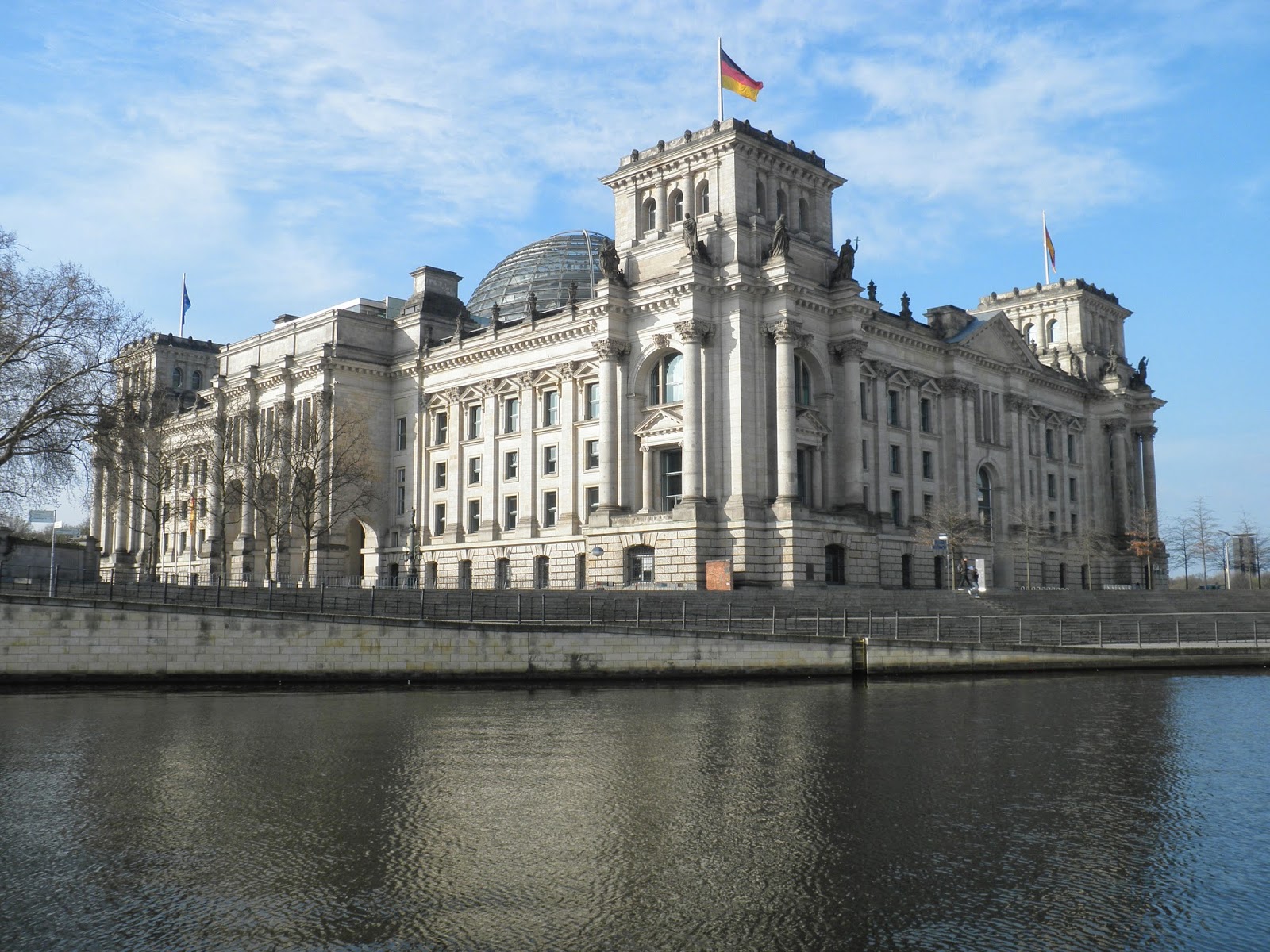
Berlin must be developer/builder heaven at the moment. For architects as well. There is so much activity - a new underground linking the main railway station with Alexanderplatz which for the moment leaves part of Unter den Linden fenced off by builders' barriers. As the panorama below shows this is by no means all of it. And Berlin is supposed to be a poor city by German standards!!
I am here in Berlin for three weeks for several reasons. One is as a Visiting Professor in the Umwelt (Environmental) Governance Group at Humbolt University. Last Tuesday I presented the following paper to a small colloquium concerned with institutions and climate change adaptation:
Ison, R.L. (2014) Tales of a normal
distribution: designing institutions for adaptation. Proc. IV. Albrecht Daniel
Thaer Kolloquium: “Institutional Economics & Climate Adaptation, March 18,
2014, Humboldt Universität zu Berlin.
The presentation stimulated some good discussion. Next week I deliver a seminar. I am also here to co-run a Systems PhD training course in conjunction with the European Farming Systems Conference. We have 25 students who will begin the program on Sunday 30th March and finish Saturday 5th April. The students are mainly from Europe but international in their spread. I am also co-convenor of Theme 1.3 in the conference program - Innovation Platforms as Drivers of Institutional Change. With other colleagues I am also co-convenor of a session organised around the re-emergence of interest in Systems within the CGIAR called: "Global Issues: Rebuilding a Systems capability?"
This is not my first visit to Berlin but will be my longest - I would not say I know the city very well, so getting to know Berlin better is also an ambition of my stay. Last night I took in a concert at the Berlin Philharmoniker - concert for flute and orchestra by Carl Reinecke and Gustav Mahler's 4th Symphony. Yannick Nezet-Seguin was the conductor. It was a great evening.
Unlike London the parks in Berlin are not full of flowers - if you look hard there is the odd daffodil and some tulips may bloom soon. Dussman's has to be among the great bookshops. The panorama from the balcony near the top of the Französische Friedrichstadtkirche makes the climb worthwhile. The Jewish buildings near where I am staying in TucholskyStr and OranienbergerStr have constant police guards.
On my first morning I had breakfast in the Restaurant Dressler on Unter den Linden. I was the first customer. Later the conversation at a nearby table was between two American women (from a major energy company) and two German men. The conversation was about future directions of energy policy. I was pleased to hear the Germans debunking the US commitment to the concept of baseload...and arguing that wind and solar were central to any future energy mix.
Last night I had a great meal at the Martin-Gropius-Bau, one of Lonely Planet's better recommendations, and far more convivial -
for me - than the modern hype of Potsdammer Platz and the Sony Centre. Over dinner the first night the conversation was about the possibilty of war triggered by events in Ukraine...more-or-less, just down the road!. Having seen the BBC program '37 Days' about the lead up to the First World War I left dinner hoping that history would not place us in some similar count down!
Ray Ison, Professor in Systems at the UK Open University since 1994, is a member of the Applied Systems Thinking in Practice Group. From 2008-15 he also developed and ran the Systemic Governance Research Program at Monash University, Melbourne. In this blog he reflects on contemporary issues from a systemic perspective.
Monday, March 24, 2014
Monday, March 10, 2014
Systems Dynamics News
Are you a book collector?
Back in
August, Jay Forrester, Bob Eberlein, and numerous Society officers and
members convened to discuss how to keep the important publications
previously sold by Pegasus Communications in circulation.
We are very excited to announce the new home for these books is at the
System Dynamics Society. These are some of the best teaching books in
the field. The Society’s goal is to keep these books available – they
are now on sale at here:
http://www.systemdynamics.org/books-for-sale/.
We see this as a huge benefit to the field. To celebrate the launch of the sale of these books through the Society, we are auctioning off a rare first edition signed copy of your favorite author’s book, World Dynamics. It is a great book, but a signed first edition is even better. Have this unique book on your library shelf and help support the System Dynamics Society!
Please visit the Books For Sale site to see the list of the eighteen titles and to learn how to participate in the auction.
See also details of the SD conference in Delft, the Netherlands from July 20-24.
We see this as a huge benefit to the field. To celebrate the launch of the sale of these books through the Society, we are auctioning off a rare first edition signed copy of your favorite author’s book, World Dynamics. It is a great book, but a signed first edition is even better. Have this unique book on your library shelf and help support the System Dynamics Society!
Please visit the Books For Sale site to see the list of the eighteen titles and to learn how to participate in the auction.
See also details of the SD conference in Delft, the Netherlands from July 20-24.
Roberta Spencer, Executive Director
System Dynamics Society
300 Milne Hall, 135 Western Avenue
Albany, NY 12222
www.systemdynamics.org
office@systemdynamics.org
Tuesday, March 04, 2014
Understanding agricultural extension still important - the case of Iran
I have received word of the following conference. Our work in this field has an Iranian connection. In 1989 we wrote:
Russell, D.B., Ison, R.L., Gamble, D.R. & Williams, R.K. (1989) A Critical Review of Rural Extension Theory and Practice. Australian Wool Corporation/ University of Western Sydney (Hawkesbury). 67pp.
Soon after this publication was translated into French and then Farsi.
i)
French
Edition: (1991). Analyse Critique de la Theorie et de la Pratique de Vulgarisation
Rurale en Australie. INRA, France. 79pp.
ii)
Persian Edition: (1995). The translation into Persian by Ahmad
Khatoonabadi.
The organiser Esmail Karamidehkordi writes:
"It is a pleasure to inform you that the University of Zanjan and the Iranian Agricultural Extension and Education Association (IAEEA) are organizing The First International Conference of the APIRAS & the Fifth Congress of Extension and Education in Agriculture and Natural Resources Management: “Facilitating Information and Innovations for Empowering Family Farmers”in 2-4 September 2014, with the collaboration of the Global Forum for Rural Advisory Services (GFRAS), the Asian and Pacific Islands Rural Advisory Services (APIRAS), World Rural Forum (WRF), the University of Tehran, Iranian Ministry of Jihad-e-Agriculture, Iranian Ministry of Cooperatives, Labour and Social Welfare, and other international and national institutions.
Because family farming is a very important farming system in the world, particularly in developing countries, we preferred to call the main theme of this conference as “Facilitating Information and Innovations for Empowering Family Farmers”. On behalf of the conference scientific committee, I would like to invite you to participate in this conference through your paper submission or supporting it as an institutional partner. The website is accessible through http://iaeea2014.znu.ac.ir and you can submit your abstract and paper online. I will appreciate your kind support if you add this link to your website and introduce it to your colleagues to participate in. We hope this international conference can provide an opportunity for the participants to share their knowledge and experiences regarding rural development and extension approaches to support family farming. Please let me know should you have any questions regarding the conference and your participation."
Friday, February 28, 2014
The worldwide systems movement is gaining momentum?
As posted a few days ago there is a lot happening in the cybersystemic world this year. Is this a sign of a new momentum? Folk running EMCSR this year claim this is the case.
Other events this year include:
1. EMCSR
A marvellous programme is already shaping up for the European Meetings on Cybernetics and System Research EMCSR 2014, 22-15 April 2014 in Vienna.
The keynotes by Mario Bunge, John Collier, and Markus Schwaninger are confirmed. Three theme chairs will open the meetings and lead into the themes of Sustainability & Development, Emergence & Design, and Complexity & Strategy. Three theme speeches will set a special focus in these storylines. Distinguished lectures are confirmed in diverse symposia. Diverse Demonstrations like the Evolutionary Learning Labs, a movie screening (Population Boom) and discussion with the acclaimed Austrian director Werner Boote (Plastic Planet) and Systems Analysis for Informing Policy by the renowned International Institute for Applied Systems Analysis will showcase impactful systems thinking and practice.
Do not miss the opportunity to become a contributor and participant, too. The deadline for the call for papers and participation is still open until 28 February 2014. Choose among the symposia to meet your interests and submit your contribution.
Tell your colleagues and friends. They might want to receive the newsletter of the EMCSR, which will be the meetings magazine in the upcoming two months, featuring you, the particpants, organizers, and your research and practice.
Join the EMCSR 2014 community. We are looking forward to welcome you in Vienna from 22-25 April 2014.
At EMCSR organised by University of Maribor, Slovenia
Eva Schernhammer, Matjaz Mulej, and Simona Krajnc
are organizing a Symposium on Systemic approaches to hunger and obesity: discoveries, innovations, and policies for the global food & health system.
We would be delighted if you/your colleagues would participate.
Especially the link to social responsibility, innovation, climate
change, public policy, transdisciplinarity, agriculture, etc. would be
very much welcome. See the EMCSR website.
2. WOSC Event in Colombia, October 2014
Our self-organising world: from disruption to reparation
Systems and cybernetics applied to technology, design, governance and power
WOSC's 16th Congress: Organised by the Universidad de Ibagué, Colombia and the World Organisation of Systems and Cybernetics, 15-17 October, 2014
Call for Abstracts
Instructions for abstract submissions to the Congress themes are given below:
The call is for extended abstracts of about 1000 words with the 31st March as a deadline. The deadline to submit full papers, of about 5000 words, is 30th September; however the focus for now is extended abstracts.
Calls for papers for symposia are open until 31 March 2014. Please be aware of the time deadlines! Refer to the Congress website: http://wosc-congress.unibague.edu.co/
Submitters will be notified of acceptance or rejection no later than the 30th of April. The earlier you submit, the earlier you can be notified, since the review of your abstract is an ongoing process.
Detailed submission instructions are available at the http://wosc-congress.unibague.edu.co/index.php/instruction-for-authors
Accepted abstracts will be accessible to all authors on the Congress website
sincerely yours
WOSC team
A marvellous programme is already shaping up for the European Meetings on Cybernetics and System Research EMCSR 2014, 22-15 April 2014 in Vienna.
The keynotes by Mario Bunge, John Collier, and Markus Schwaninger are confirmed. Three theme chairs will open the meetings and lead into the themes of Sustainability & Development, Emergence & Design, and Complexity & Strategy. Three theme speeches will set a special focus in these storylines. Distinguished lectures are confirmed in diverse symposia. Diverse Demonstrations like the Evolutionary Learning Labs, a movie screening (Population Boom) and discussion with the acclaimed Austrian director Werner Boote (Plastic Planet) and Systems Analysis for Informing Policy by the renowned International Institute for Applied Systems Analysis will showcase impactful systems thinking and practice.
Do not miss the opportunity to become a contributor and participant, too. The deadline for the call for papers and participation is still open until 28 February 2014. Choose among the symposia to meet your interests and submit your contribution.
Tell your colleagues and friends. They might want to receive the newsletter of the EMCSR, which will be the meetings magazine in the upcoming two months, featuring you, the particpants, organizers, and your research and practice.
Join the EMCSR 2014 community. We are looking forward to welcome you in Vienna from 22-25 April 2014.
At EMCSR organised by University of Maribor, Slovenia
2. WOSC Event in Colombia, October 2014
Our self-organising world: from disruption to reparation
Systems and cybernetics applied to technology, design, governance and power
WOSC's 16th Congress: Organised by the Universidad de Ibagué, Colombia and the World Organisation of Systems and Cybernetics, 15-17 October, 2014
Call for Abstracts
Instructions for abstract submissions to the Congress themes are given below:
The call is for extended abstracts of about 1000 words with the 31st March as a deadline. The deadline to submit full papers, of about 5000 words, is 30th September; however the focus for now is extended abstracts.
Calls for papers for symposia are open until 31 March 2014. Please be aware of the time deadlines! Refer to the Congress website: http://wosc-congress.unibague.edu.co/
Submitters will be notified of acceptance or rejection no later than the 30th of April. The earlier you submit, the earlier you can be notified, since the review of your abstract is an ongoing process.
Detailed submission instructions are available at the http://wosc-congress.unibague.edu.co/index.php/instruction-for-authors
Accepted abstracts will be accessible to all authors on the Congress website
sincerely yours
WOSC team
Wednesday, February 26, 2014
'Systems Practice' Traineeships
Louis Klein from the SystemicExcellence Group advises that:
"we are currently looking for professionals to join us at the SEgroup Intelligence Hub in Berlin. Please circulate this call to people who are looking for a new rewarding opportunity."
Call for Traineeship in Berlin
Systemic Change and global responsibility in management and advisory practices lie at the very heart of your professional interest. You want to know how change projects work, how social complexity in politics and culture can be met and what the next level of organisational excellence looks like. You are a professional, driven by an entrepreneurial spirit looking for the opportunity to make a difference. You have a master’s degree or equivalent and would describe yourself as someone of high integrity and reliability. You are eager to learn from every theoretic and practical encounter. Reflection in action is your second nature. And, most importantly, your friends like you as a supportive and caring person.
The Systemic Excellence Group is an independent think & do tank in the field of systemic change with over 12 years of experience. As a global cooperative we feature offices in nearly all parts of the world. Our members are driven by an entrepreneurial spirit to realise change excellence – not only in organisations, but aiming at changing the change towards more efficientpractices, based on global responsibility.
The goal of the traineeship is to give professionals the opportunity to experience this challenging and unique approach. Situated in SEgroup’s Global Intelligence Hub in Berlin, trainees are given the chance to manage SEgroup development projects, learning and applying SEgroup knowledge & expertise in genuine change projects. This approach allows our trainees to face all challenges of a client project in a supportive and save environment. At the same time they become an essential part of the continuous learning journey of SEgroup, hence we encourage our trainees to challenge our perspectives and practices.
After the six-month traineeship, trainees have the opportunity to apply for a Consortional Partner role and become a member of the cooperative. For the traineeship a moderate remuneration will be granted.
Current Projects Looking for Support
"we are currently looking for professionals to join us at the SEgroup Intelligence Hub in Berlin. Please circulate this call to people who are looking for a new rewarding opportunity."
Call for Traineeship in Berlin
Systemic Change and global responsibility in management and advisory practices lie at the very heart of your professional interest. You want to know how change projects work, how social complexity in politics and culture can be met and what the next level of organisational excellence looks like. You are a professional, driven by an entrepreneurial spirit looking for the opportunity to make a difference. You have a master’s degree or equivalent and would describe yourself as someone of high integrity and reliability. You are eager to learn from every theoretic and practical encounter. Reflection in action is your second nature. And, most importantly, your friends like you as a supportive and caring person.
The Systemic Excellence Group is an independent think & do tank in the field of systemic change with over 12 years of experience. As a global cooperative we feature offices in nearly all parts of the world. Our members are driven by an entrepreneurial spirit to realise change excellence – not only in organisations, but aiming at changing the change towards more efficientpractices, based on global responsibility.
The goal of the traineeship is to give professionals the opportunity to experience this challenging and unique approach. Situated in SEgroup’s Global Intelligence Hub in Berlin, trainees are given the chance to manage SEgroup development projects, learning and applying SEgroup knowledge & expertise in genuine change projects. This approach allows our trainees to face all challenges of a client project in a supportive and save environment. At the same time they become an essential part of the continuous learning journey of SEgroup, hence we encourage our trainees to challenge our perspectives and practices.
After the six-month traineeship, trainees have the opportunity to apply for a Consortional Partner role and become a member of the cooperative. For the traineeship a moderate remuneration will be granted.
Current Projects Looking for Support
- Sharing our knowledge, revisiting SEgroup’s action research based learning journey, conceptualising and implementing ways of sharing our knowledge with a larger stakeholder community.
- Co-creating discourses in the field of project management, consulting and leadership by building communities driven by a systemic mind-set and a sense of global responsibility.
- Growing SEgroup as a global cooperative refining our operating model and cascading its procedural, structural and personal implications towards a desirable next practice.
New Elinor Ostrom Prize
A prize of £1000 is awarded each year for the best full-length article published in the
Journal of Institutional
Economics
in the preceding calendar year.
Each annual prize competition will be judged by an international committee of experts in the field of institutional research. The award is funded by the Foundation for European Economic Development. Approval to use the Ostrom name has been obtained from the Indiana University Foundation.
The first Elinor Ostrom Prize will be awarded in 2014 for the best full-length article published in the Journal of Institutional Economics in 2013. The award will be made at the conference of the World Interdisciplinary Network for Institutional Research, in Greenwich, London, UK on 11-14 September 2014.
Each annual prize competition will be judged by an international committee of experts in the field of institutional research. The award is funded by the Foundation for European Economic Development. Approval to use the Ostrom name has been obtained from the Indiana University Foundation.
The first Elinor Ostrom Prize will be awarded in 2014 for the best full-length article published in the Journal of Institutional Economics in 2013. The award will be made at the conference of the World Interdisciplinary Network for Institutional Research, in Greenwich, London, UK on 11-14 September 2014.
Monday, February 17, 2014
Daughters as activists
It is one of life's great gifts if it comes your way - to be proud of one's offspring in doing what they choose to do.
Here I share some links to daughters who care about the world's they live and help to create. One of a colleague, in the field of youth unemployment:
AltGen supports 18-25 year old's to set up workers cooperatives as an empowering and collaborative solution to youth unemployment. To get involved and find out more, visit their website, facebook page, or tweet @AltGen101.
See also these Blogs by Rhiannon: Diary of a young co-operative startup and The importance of collaboration published in the Guardian Social Network section.
And the others are Nicky and Jarra who co-established the Comunity Power Agency and are busy preparing for Australia's first National "Community Energy Congress" concerned with community-based renewable energy.
Here I share some links to daughters who care about the world's they live and help to create. One of a colleague, in the field of youth unemployment:
AltGen supports 18-25 year old's to set up workers cooperatives as an empowering and collaborative solution to youth unemployment. To get involved and find out more, visit their website, facebook page, or tweet @AltGen101.
See also these Blogs by Rhiannon: Diary of a young co-operative startup and The importance of collaboration published in the Guardian Social Network section.
And the others are Nicky and Jarra who co-established the Comunity Power Agency and are busy preparing for Australia's first National "Community Energy Congress" concerned with community-based renewable energy.
News from Systems Thinking in Action
- For those of you not aware of it there is a LinkedIn group called Systems Thinking in Action organised by Gene Bellinger. It is worth joining in if you have time and enthusiasm. Here is a copy of Gene's latest missive.
Aren't the conversations about the broader adoption of systems thinking and the multitude of models and methods therein pretty much legion?
If systems thinkers are unable to effect the broader adoption of systems thinking what does that imply about systems thinking and systems thinkers?
Are systems thinkers the primary impediment to the broader adoption of systems thinking?
Are statements like, "Only 5% of people are capable of systems thinking," helpful?
Are the most knowledgeable on the subject functioning in a context which ensures they are off-putting to almost anyone not in the same context?
Simon Sinek indicated it was essential to begin with Why? Have we followed this guidance? http://bit.ly/1ku7maR
Isn't a commonly offered definition of insanity doing the same things and expecting different results?
Are systems thinkers the poster children for Pogo's "We have met the enemy and he is us?"
If tomorrow is to be better than today then isn't it’s up to me, and you, for if not us, then who?
The Kumu Manifesto seems well worth the read...
* https://kumu.io/manifesto
Your thoughts?
P.S. FYI...
* Systems Thinking in Action Conference April 16th to 18th in Seattle… http://bit.ly/1eqeqNk
* European Meeting on Cybernetics and Systems Research April 22nd to 25th in Vienna… http://bit.ly/1bfhNwa
* System Dynamics Society Conference July 20th to 24th in Delft… http://bit.ly/XKdrFm
Cyber-Systemic events in 2014
For those who may not be hooked into the various cybernetic and systems societies there is much that is on this year to distract, enthuse, activise or sustain friendships:
2. ISSS 2014 Conference - ISSS, and ASC in the following week
Further details are located on the ISSS2014 Conference pages.
This year, the ASC meeting "Living in Cybernetics" will also be held at GWU in the week following the ISSS (3-9th August). There will be a discount for those attending both conferences, please see each conference's registration pages. The discount will be halved from the registration cost of each conference.
Additional details will be added as available, please email the ISSS office with any queries in the meantime at isssoffice@dsl.pipex.com
3. 50th Anniversary conference of the American Society for Cybernetics
2014 marks the 50th anniversary of the American Society for Cybernetics, which was incorporated in Washington DC on the 6th of August 1964.
Our conference this year will be our major celebration. The theme is “Living in Cybernetics”. The main event (4 to 8 August inclusive) will celebrate ASC cybernetics in the present through paper presentations themed using Stuart Umpleby’s “Several Traditions of cybernetics” (4 and 5 August), ASC cybernetics in the past through addresses from many past presidents and other long term members (August 6) developing our timeline, and ASC cybernetics in the future through workshops developing views of how cybernetics and education may come together to hep make a better world (August 7 and 8).
In addition, as has been our recent practice, we will hold a pre-conference meeting on 3 August; and a post-conference meeting (9 August). Conferees may attend these events without charge.
1. First Call for Papers: UK Systems Society International Conference 2014
9-11 September 2014 - St Anne’s College, Oxford University, UK
What are knowledge societies?
Knowledge Societies are identified as societies
based on the creation, dissemination and utilization of information and
knowledge, i.e. societies with an economy in which knowledge is
acquired, created, disseminated and applied to enhance
economic and social development. People living in a knowledge society
can expect that their work, leisure, social and political lives will be
dominated by creation, acquisition and utilisation of ‘knowledge’.
However, at the heart of this concept is the idea
of ‘knowledge’ itself. Much has been written about knowledge in its
various forms – propositional knowledge (information) or tacit
‘know-how’. Great resources have been expended by businesses wishing to
know how to manage their knowledge, since it has been
acknowledged that the only sustainable source of competitive advantage
that an organisation has is the know-how of the people it employs. Yet
knowledge remains problematic. It is contained within people and created
by them through interactions in groups, using
physical and financial resources. People may or may not know that they
have it. Efforts to make human knowledge explicit, and capture it for
the benefit of others may be more or less successful. It is perhaps
more accurate to refer to human knowing, since
it is dynamic rather than static.
Challenges of knowledge societies
With increased focus on the economic and social
aspect of knowledge, its potential as a force of social cohesion and
increased welfare, or conversely as a source of increased division and
exclusion requires our urgent attention as citizens.
UNESCO, in a 2005 World Report on Knowledge Society, has expressed
concern over the potential disassociation of society as those on the
wrong side of the digital divide become increasingly isolated. Further
concern is expressed over excessive commoditization
of knowledge, so that ownership of previously social assets become
concentrated in the hands of the powerful.
The UNESCO World Report establishes four principles that are essential for development of an equitable knowledge society:
- Cultural diversity;
- Equal access to education;
- Universal access to information (in the public domain);
- Freedom of expression.
The role of technology
“Knowledge has been at the heart of economic
growth and development for some time. Despite the shift in recent years
from the Information Society to an emerging global knowledge society,
where emphasis is more on people’s utilisation
of knowledge rather than technology, it still remains a fact that
information technology remains a central element of the knowledge
society, combined with continuous learning particularly in Science &
Technology and innovation … The ability to generate new
knowledge and new ideas that are then embodied in products and
organisations has always served to fuel development … The foremost use
of knowledge should be to empower and develop all sectors of society to
understand and use knowledge to increase the quality
of people’s lives and promote social development. A socially inclusive
knowledge society empowers all members of the society to create,
receive, share and use information and knowledge for their economic,
social, cultural and political development. In recent
times, disparities in the productivity and growth of different
countries have far less to do with the abundance or lack of natural
resources than with the capacity to improve the quality of human capital
and factors of production i.e. to create new knowledge
and ideas and incorporate them into equipment and people’s skills.”
(Extract from a GESCI report, funded by the UN ICT Task Force, 2010)
Systems and the knowledge society – Call for Contributions
What is clear from this discourse is that
knowledge society is characterised by its complexity. Not only is
knowledge an ephemeral phenomenon, resistant to attempts to harness and
control it, but it is a controversial asset that gives
access to economic and political power. One thing that is clear is that
the four principles set out by UNESCO cannot be achieved through linear
thinking.
We invite contributions from systems thinkers in
the form of papers, models, reports from practice, posters or workshop
proposals that relate to the conference theme in its broadest sense. The
Conference programme will include a day devoted
to practitioner contributions, and a workshop on writing for
publication as well as plenary presentations and speakers (to be
confirmed).
Papers should be clearly marked ‘conference
submission’, and submitted by 31 May 2014, via the on-line submission
system of IGI Global. For other types of contribution, please email an abstract to the conference organisers at: Conference2014@ukss.org.uk
2. ISSS 2014 Conference - ISSS, and ASC in the following week
Learning Across Boundaries: Exploring the Variety of Systemic Theory and Practice
ISSS President 2013-14 Professor Gerald Midgley, University of Hull, UK
The 58th Meeting of the International Society for the Systems Sciences will be held at George Washington University, Washington DC, July 27 through August 1, 2014. The conference will be held at the downtown campus in the Georgetown area of Washington DC at Funger Hall, GWU School of Business.Further details are located on the ISSS2014 Conference pages.
This year, the ASC meeting "Living in Cybernetics" will also be held at GWU in the week following the ISSS (3-9th August). There will be a discount for those attending both conferences, please see each conference's registration pages. The discount will be halved from the registration cost of each conference.
Additional details will be added as available, please email the ISSS office with any queries in the meantime at isssoffice@dsl.pipex.com
3. 50th Anniversary conference of the American Society for Cybernetics
2014 marks the 50th anniversary of the American Society for Cybernetics, which was incorporated in Washington DC on the 6th of August 1964.
Our conference this year will be our major celebration. The theme is “Living in Cybernetics”. The main event (4 to 8 August inclusive) will celebrate ASC cybernetics in the present through paper presentations themed using Stuart Umpleby’s “Several Traditions of cybernetics” (4 and 5 August), ASC cybernetics in the past through addresses from many past presidents and other long term members (August 6) developing our timeline, and ASC cybernetics in the future through workshops developing views of how cybernetics and education may come together to hep make a better world (August 7 and 8).
In addition, as has been our recent practice, we will hold a pre-conference meeting on 3 August; and a post-conference meeting (9 August). Conferees may attend these events without charge.
4. EMCSR 2014
“Dear Colleagues,
We are happy to invite you to participate in the
European
Meetings on Cybernetics and Systems Research in Vienna, 22nd to 25th of April 2014.
At
EMCSR, scientists, organizations, researchers and practitioners share
their experiences working with systems theory and practice.
This
year's meeting is a co-production of the most distinguished systems
organizations and communities in the world and in addition will connect
members
of the International Federation for Systems Research and EMCSR with the
intent to create a hub that showcases the advance of systems approaches
to contribute to solutions of today’s complex problems.
The Symposia
Call for Papers timeline is 28th February, 2014
The EMCSR 2014: “Civilisation at the Crossroads: Response and Responsibility of the Systems Sciences”
will
be guided by three story lines, each comprised by the perspectives of
concepts, applications and bridges between academia and practice:
I. Sustainability and Development
II. Emergence and Design
III. Complexity and Strategy
There are specific topics under each theme.
(Read
more)
The PhD
Day call for papers timeline is 14th February
The EMCSR 2014 PhD Colloquium & Award
is
a special topic of the EMCSR 2014 with paper presentations from
scientists in pre-doctoral or early post-doctoral phases of work.
One of the highlights of the EMCSR Colloquium & Award is the special “Ludwig von Bertalanffy Young Scientist Award”, which consists of a diploma and a monetary prize.
(Read
more)
Please find the information pertaining to this event at the following URL
http://emcsr.net/
and share it with all friends and colleagues you know whom you think
might be interested in this event, and distribute it to other academic
institutions and organizations far and wide.
Sign up to our EMCSR newsletter for updates and information like community and background stories and project features!
Newsletter
Subscribe to:
Posts (Atom)